Greenwashing happens when a company makes a product, service, or brand look more environmentally friendly than it really is. It can appear through words, images, packaging, labels, symbols, advertisements, or sustainability promises. The main problem is that greenwashing can mislead people into trusting claims that are vague, exaggerated, false, or not supported by clear evidence.
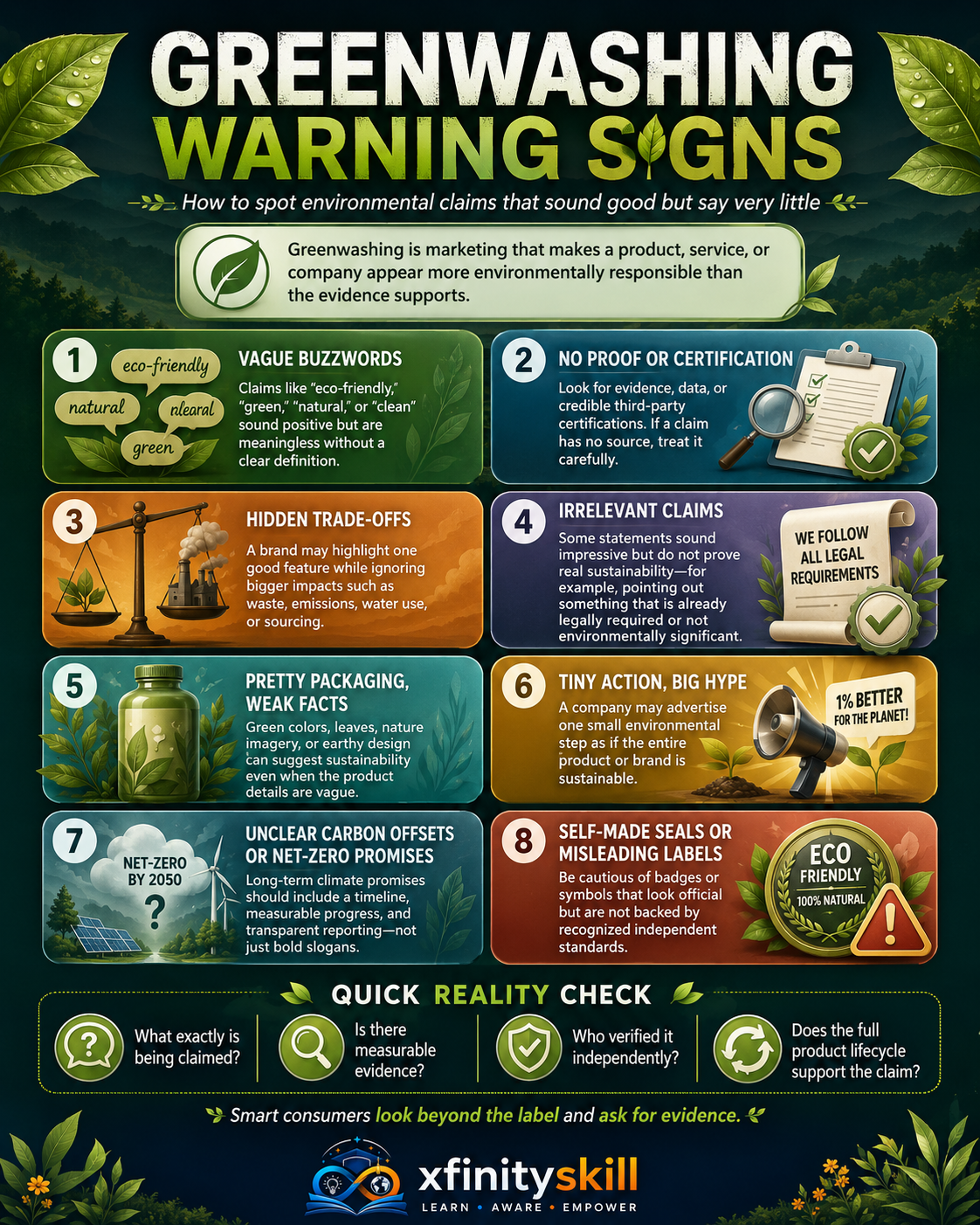
1. Vague Green Words
Be careful when a product uses words like “eco-friendly,” “green,” “natural,” “planet-safe,” or “sustainable” without explaining what they mean. A trustworthy claim should be specific. For example, “made with 80% recycled paper” is clearer than simply saying “good for the planet.”
2. No Proof or Evidence
A major warning sign is when a company makes a strong environmental claim but does not provide reliable proof. Real green claims should be backed by clear information, testing, data, or recognized standards. If there is no evidence, the claim may only be marketing.
3. Hidden Trade-Offs
Sometimes a product highlights one positive feature while hiding bigger environmental problems. For example, packaging may be recyclable, but the product itself may still create high waste, pollution, or emissions. A good claim should not distract from the full environmental impact.
4. Misleading Images and Symbols
Green leaves, trees, animals, water drops, earthy colors, and recycling icons can make a product look environmentally responsible. However, design alone is not proof. A product can look “green” without actually having strong environmental benefits.
5. Unverified Labels or Fake Certifications
Some products use seals, badges, or certification-style graphics that look official but are not backed by an independent or recognized organization. A trustworthy label should be easy to verify and should clearly explain who certified it and what standard was used.
6. Exaggerated Claims
Be cautious when a company claims a product is “100% green,” “zero impact,” or “completely harmless to the environment.” Most products have some environmental impact. Strong claims need strong evidence.
7. Unclear Comparisons
Claims like “better for the environment,” “less waste,” or “greener than before” should explain what the product is being compared to. A reliable comparison should identify the old product, competitor, time period, or measurement used.
8. Future Promises Without a Real Plan
Companies may promise to become “net zero,” “carbon neutral,” or “fully sustainable” in the future. These promises should include realistic steps, timelines, progress updates, and verifiable plans. Without details, future goals may be more about image than action.
9. Overemphasis on Small Actions
A company may promote a small green action, such as changing packaging, while ignoring larger environmental issues in production, transportation, waste, or supply chains. A meaningful claim should reflect real impact, not just a small improvement used for publicity.
10. Hard-to-Find Information
If a company makes environmental claims but hides the details in confusing language, tiny print, or hard-to-find webpages, that is a warning sign. Trustworthy information should be clear, accessible, and understandable.
Quick Consumer Checklist
Before trusting a green claim, ask:
- What exactly is being claimed?
- Is there proof?
- Who verified it?
- Is the claim specific or vague?
- Is the company showing the full picture?
- Are future goals supported by a realistic plan?
- Does the label or certification come from a credible source?
Key Message
A real environmental claim should be clear, honest, specific, and supported by evidence. If a claim sounds too perfect, too vague, or too difficult to verify, it may be greenwashing.