Deep Learning & Neural Networks are at the forefront of artificial intelligence, revolutionizing how machines learn from data. These technologies mimic the human brain’s structure and function, allowing computers to process vast amounts of information and recognize patterns with remarkable accuracy.
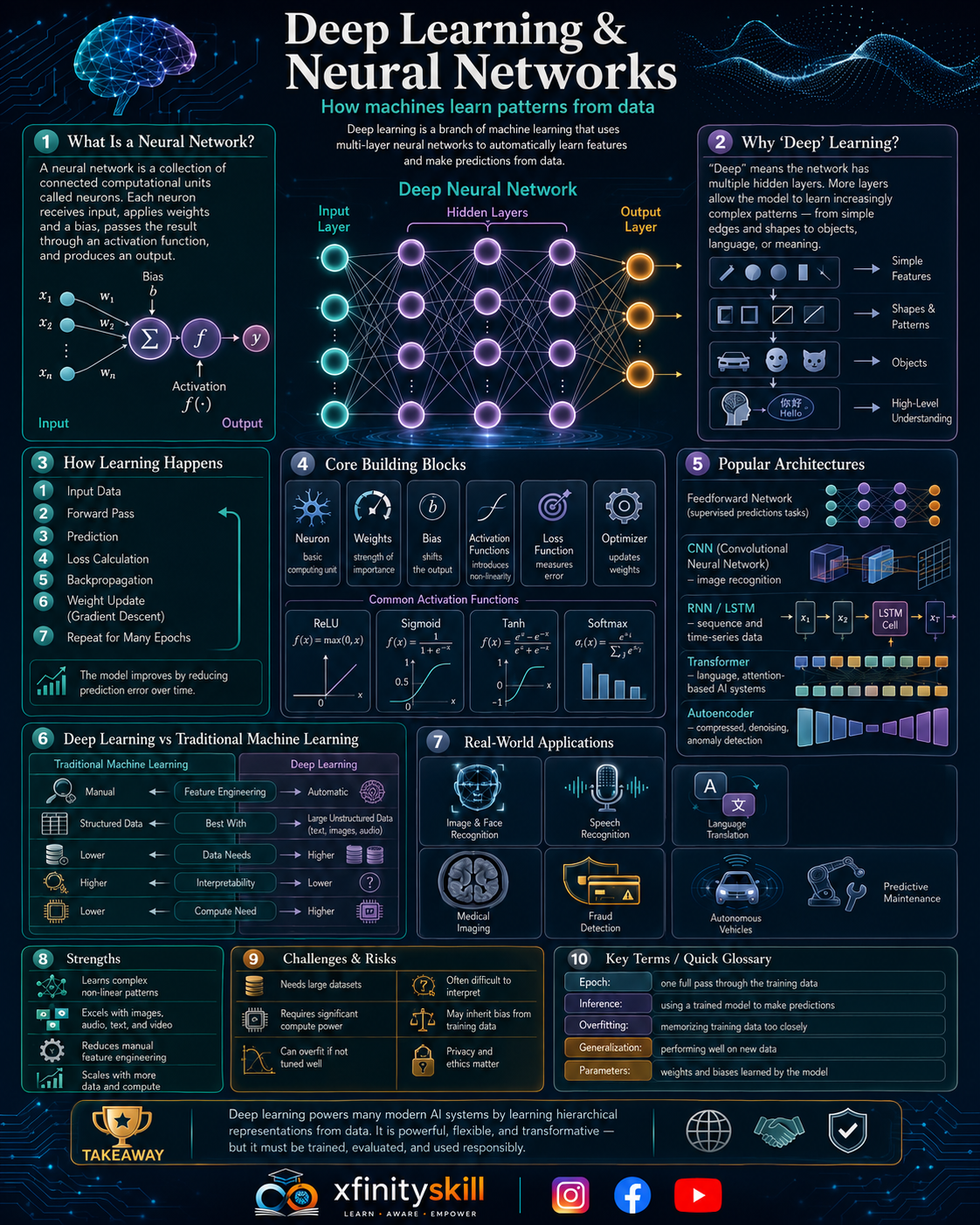
Neural networks consist of layers of interconnected nodes, or neurons, which process input data. The architecture typically includes an input layer, one or more hidden layers, and an output layer. Each connection between neurons has an associated weight that adjusts as the network learns, enabling it to minimize errors in predictions.
Deep learning, a subset of machine learning, utilizes deep neural networks with many layers. This depth allows the model to learn complex representations of data, making it particularly effective for tasks such as image and speech recognition, natural language processing, and even game playing.
Key advantages of deep learning include:
- Automatic Feature Extraction: Unlike traditional machine learning, deep learning models automatically identify relevant features from raw data, reducing the need for manual feature engineering.
- Scalability: Deep learning models can handle large datasets, making them suitable for big data applications.
- High Performance: With sufficient data and computational power, deep learning models often outperform other algorithms in accuracy.
However, deep learning also comes with challenges:
- Data Requirements: These models require large amounts of labeled data to train effectively.
- Computational Resources: Training deep neural networks can be resource-intensive, necessitating powerful hardware and significant time.
- Interpretability: The complexity of deep learning models can make it difficult to understand how they arrive at specific decisions, raising concerns in critical applications.
In conclusion, Deep Learning & Neural Networks are transformative technologies that continue to evolve, driving advancements across various fields. As research progresses, we can expect even more innovative applications that harness the power of these intelligent systems.